
 EN
EN
 English
 Client
What Is Margin Trading?
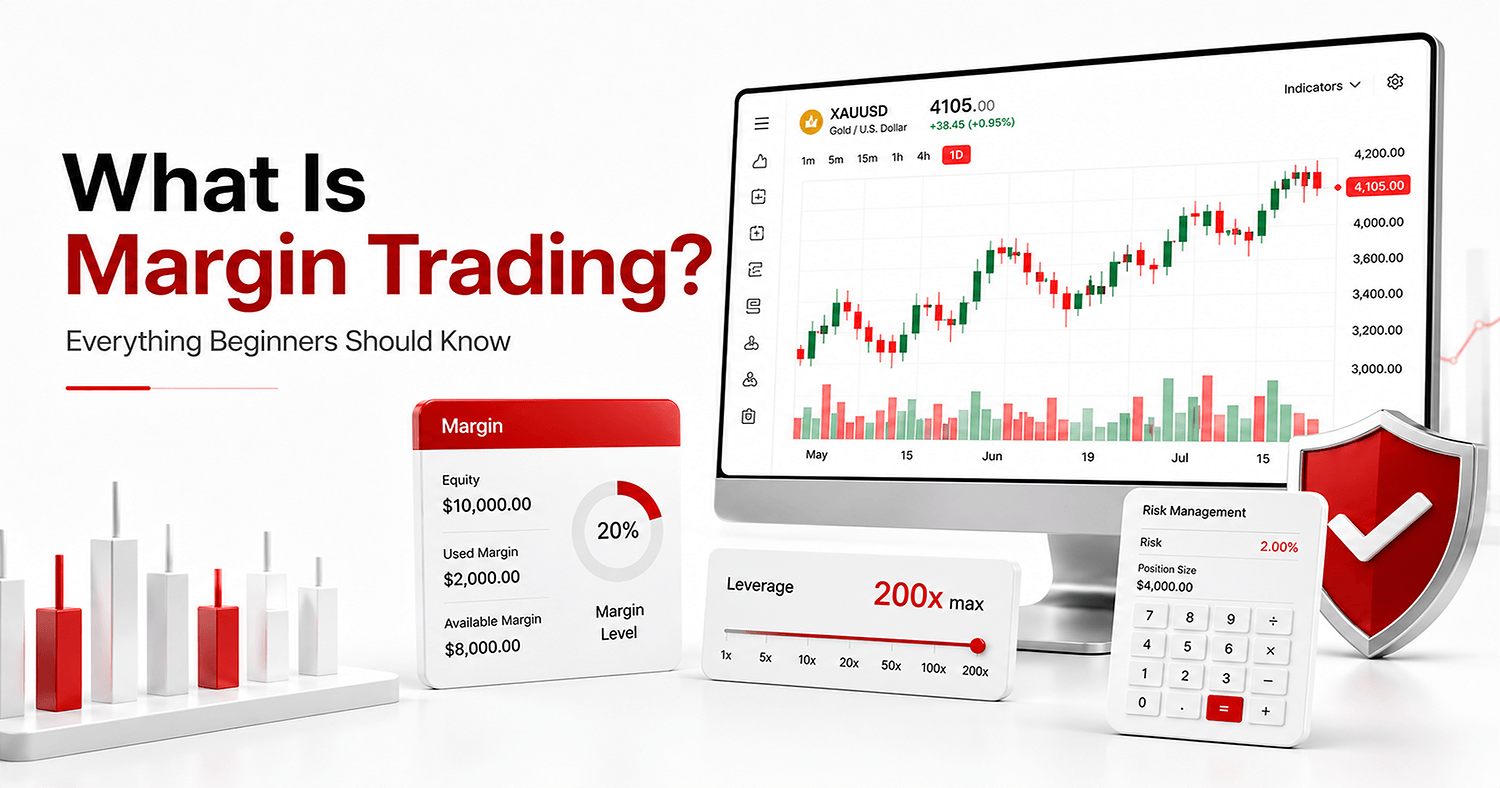
Margin trading is a trading method that allows traders to open larger market positions by using a smaller amount of capital called margin. Instead of paying the full value of a trade, the trader deposits a required margin, while the broker provides leveraged market exposure.
Margin trading is commonly used in forex trading, gold, indices, commodities, CFDs, and global equities trading. It can increase market exposure, but it also increases risk because both profits and losses are calculated on the full trade size, not only on the margin amount.
For beginners, margin trading should be understood as a risk-managed trading tool, not a shortcut to quick profit.
Key Takeaways
Margin trading allows traders to control larger positions with smaller capital.
Margin is the amount required to open and maintain a leveraged trade.
Leverage increases both potential profits and potential losses.
A margin call happens when account equity becomes too low compared to used margin.
Stop-out may automatically close open trades when the margin level falls below the broker’s required limit.
Beginners should use stop-loss, controlled lot size, low leverage, and proper risk management.
Before trading on margin, traders should always read the broker’s risk disclosure.
Introduction
Margin trading is one of the most important concepts every beginner should understand before entering the financial markets. Whether you trade forex, gold, indices, commodities, stocks, or CFDs, margin directly affects how much market exposure you can take, how much risk you carry, and how your trading account responds to price movement.
Many new traders are attracted to margin trading because it allows them to access larger positions with a smaller account balance. This flexibility can be useful, but it also comes with serious risk. A small market movement can create a large profit or loss depending on leverage, lot size, and position value.
That is why margin trading should never be treated as an easy way to increase profit. It is a powerful trading mechanism that requires education, discipline, risk control, and emotional balance.
In this beginner-friendly guide, we will explain what margin trading means, how margin and leverage work, what a margin call is, how stop-out works, and how beginners can use margin trading more responsibly.
What Is Margin Trading?
Margin trading means opening a trade position by using a small deposit called margin while controlling a larger market position through leverage.
In simple words, margin is not the full cost of the trade. It is the amount required by the broker to open and maintain a leveraged position.
For example, if a trader wants to open a position worth $10,000 and the margin requirement is 1%, the trader may need only $100 as margin.
However, the profit or loss is not calculated only on the $100 margin. It is calculated on the full $10,000 position value.
This is why margin trading can be useful, but also risky.
How Does Margin Trading Work?
Margin trading works through leverage. Leverage allows traders to control a larger position using a smaller amount of capital.
For example:
| Trade Value | Margin Requirement | Margin Needed |
| $10,000 | 1% | $100 |
| $10,000 | 2% | $200 |
| $10,000 | 5% | $500 |
| $50,000 | 1% | $500 |
| $100,000 | 1% | $1,000 |
If the market moves in your favor, your profit is based on the full trade value. If the market moves against you, your loss is also based on the full trade value.
This is the main reason why beginners must manage lot size, stop-loss, risk per trade, and free margin before opening any margin position.
Margin Trading Example for Beginners
Let’s understand margin trading with a simple example.
Suppose you have a $1,000 trading account.
You open a trade with a total position value of $10,000. The required margin is 1%.
So, the margin needed is:
$10,000 × 1% = $100
This means $100 will be locked as margin while the trade is open.
Now, if the trade moves in your favor and you make $150 profit, your equity increases. But if the trade moves against you and you lose $150, your equity decreases.
The broker does not calculate your profit or loss only on the $100 margin. The result is calculated on the full $10,000 position.
This is why margin trading requires careful risk management.
Important Margin Trading Terms Beginners Should Know
1. Margin
Margin is the amount of money required to open and maintain a leveraged trade. It works like a security deposit for your open position.
2. Required Margin
Required margin is the exact amount needed to open a trade.
Example:
If a $5,000 position requires 2% margin, the required margin is:
$5,000 × 2% = $100
3. Used Margin
Used margin is the total amount currently locked in your open trades. If you open multiple trades, each trade uses some margin. The total locked amount becomes your used margin.
4. Free Margin
Free margin is the amount available in your account after used margin is deducted from equity.
Formula:
Free Margin = Equity − Used Margin
Free margin helps your account absorb market movement. If free margin becomes too low, your account becomes more exposed to a margin call.
5. Margin Level
Margin level shows the health of your trading account.
Formula:
Margin Level = Equity ÷ Used Margin × 100
A higher margin level usually means your account has more room to handle market movement. A very low margin level can lead to a margin call or stop-out.
6. Equity
Equity is your real-time account value, including open profit or loss.
Formula:
Equity = Balance + Floating Profit/Loss
7. Balance
Balance is your account value after closed trades. It does not include open trade profit or loss.
8. Floating Profit or Loss
Floating profit or loss is the live result of your open trades. It changes as the market price moves.
What Is Leverage in Margin Trading?
Leverage is the trading power that allows traders to control a larger position with a smaller amount of capital.
Examples:
| Leverage | Meaning |
| 1:10 | Control $10 with $1 |
| 1:50 | Control $50 with $1 |
| 1:100 | Control $100 with $1 |
| 1:500 | Control $500 with $1 |
Higher leverage reduces the margin required to open a trade. However, it also increases risk because even a small price movement can create a larger impact on your trading account.
Beginners should avoid using maximum leverage. A lower leverage approach can help reduce emotional pressure and protect trading capital.
Margin vs Leverage: What Is the Difference?
Margin and leverage are closely connected, but they are not the same.
| Term | Meaning |
| Margin | The amount required to open and maintain a trade |
| Leverage | The tool that allows larger market exposure |
| Used Margin | Total money locked in open trades |
| Free Margin | Available money after used margin |
| Margin Level | Account health percentage based on equity and used margin |
In simple words, margin is the amount you need to put aside, while leverage is the power that increases your trading exposure.
What Is a Margin Call?
A margin call happens when your account equity falls too low compared to your used margin.
It is a warning that your account does not have enough available funds to safely support open trades.
A margin call may happen when:
The market moves strongly against your trade
You use high leverage
You open too many positions
You trade with large lot sizes
You do not use stop-loss
Your account has low free margin
A margin call is a serious warning. If the market continues moving against your position, the broker may automatically close some or all open trades.
Before trading with leverage, beginners should read the broker’s risk disclosure and understand how margin requirements can affect open positions.
What Is Stop-Out?
Stop-out is when the broker automatically closes one or more open trades because your margin level becomes too low.
This is usually done to reduce further account exposure when the available margin is no longer enough to support open positions.
Each broker may have different margin call and stop-out levels. That is why traders should understand the broker’s margin policy before opening trades.
To reduce the risk of stop-out, beginners should avoid overleveraging, use smaller lot sizes, and keep enough free margin in the account.
Why Do Traders Use Margin Trading?
Traders use margin trading because it allows them to access larger market opportunities with less upfront capital.
For example, without margin, a trader may need the full trade value to open a position. With margin, the trader only needs a required percentage of that value.
Margin trading is commonly used in:
Forex
Gold
Indices
Commodities
CFDs
Stocks and global equities
Traders who use platforms such as the MetaTrader 5 trading platform can monitor balance, equity, margin, free margin, and margin level directly from the trading terminal.
Benefits of Margin Trading
Margin trading can be useful when it is used responsibly.
1. Larger Market Exposure
Margin allows traders to access bigger positions without paying the full trade value upfront.
2. Better Capital Efficiency
Traders can use a smaller amount of capital to participate in larger market movements.
3. Access to Multiple Markets
Margin trading is commonly used across forex, gold, indices, commodities, CFDs, and equities.
4. Opportunity in Rising and Falling Markets
In CFD and forex trading, traders can usually buy or sell depending on market direction. This allows traders to look for opportunities in both bullish and bearish market conditions.
5. Flexible Trading Strategy
Margin trading allows traders to adjust position size based on account balance, risk tolerance, and trading style.
Risks of Margin Trading
Margin trading also carries high risk, especially for beginners.
1. Losses Can Increase Quickly
Because trades are based on the full position size, losses can become large if the market moves against you.
2. High Leverage Risk
High leverage can make small market movements dangerous for your account.
3. Margin Call Risk
If your equity drops too much, you may receive a margin call.
4. Stop-Out Risk
If your margin level becomes too low, your broker may automatically close your trades.
5. Overtrading Risk
Margin can make it easy to open multiple trades, but too many trades can quickly reduce free margin.
6. Emotional Pressure
Large positions can create stress, panic, and emotional decision-making.
For additional investor education, beginners can also read external resources such as the SEC guide on margin, FINRA’s margin call explanation, and the FCA information on CFDs.
Margin Trading in Forex
Margin trading is widely used in forex trading because currency pairs often move in smaller percentage ranges compared to some other assets.
Leverage allows forex traders to participate in currency price movements with smaller capital. However, forex markets can become highly volatile during:
Interest rate decisions
Inflation reports
Employment data
Central bank speeches
Geopolitical news
Beginners should avoid overleveraging and always use a clear stop-loss when trading forex on margin.
Margin Trading in Gold
Gold is one of the most popular assets for margin traders. It often moves strongly during market uncertainty, inflation concerns, US dollar movement, and central bank updates.
Gold trading can provide opportunities, but it can also be volatile.
A small price movement in gold can create a large profit or loss depending on lot size. Beginners should use smaller positions and avoid trading gold without a stop-loss.
Traders interested in precious metals can learn more from Zed Capital’s metals trading page.
Margin Trading in Indices
Indices such as NAS100, US30, and US500 are commonly traded using margin.
Index markets can move sharply during:
US market open
Economic data releases
Earnings season
Federal Reserve announcements
Global market sentiment changes
Because indices can move quickly, beginners should monitor margin level and avoid oversized positions.
Margin Trading in Commodities
Commodities such as crude oil, natural gas, gold, silver, copper, and agricultural products can also be traded using margin, depending on the broker’s product offering.
Commodity prices may react strongly to:
Supply and demand changes
Geopolitical events
Weather conditions
Inventory reports
Global growth expectations
Currency movements
Traders can explore Zed Capital’s commodities trading page to understand different commodity markets.
Margin Trading in Stocks and Global Equities
Some traders also use margin or leveraged products to access stock and equity market opportunities. Through global equities trading, traders can explore different regional markets and sectors.
However, equity markets can also be volatile, especially during earnings announcements, economic data releases, and major market events.
Before trading stocks or equity CFDs on margin, beginners should understand position size, market hours, spreads, commissions, and risk exposure.
How to Calculate Margin
The basic margin formula is:
Margin = Trade Size ÷ Leverage
Example:
Trade size: $10,000
Leverage: 1:100
Required margin:
$10,000 ÷ 100 = $100
So, the trader needs $100 margin to open the position.
Another way to calculate margin is by using margin percentage:
Margin = Trade Value × Margin Requirement
Example:
Trade value: $10,000
Margin requirement: 2%
Required margin:
$10,000 × 2% = $200
For better planning, traders can use a profit calculator or other trading tools to estimate potential profit, loss, and trade exposure before placing a trade.
How Beginners Can Manage Risk in Margin Trading
1. Use Low Leverage
Beginners should avoid using maximum leverage. Lower leverage can help reduce risk and protect the account from large losses.
2. Risk Only a Small Percentage Per Trade
Many traders risk only a small percentage of their account on a single trade. This helps reduce the impact of losing trades.
3. Always Use Stop-Loss
A stop-loss helps define your risk before entering the trade. Trading without stop-loss can expose your account to larger losses.
4. Avoid Full Margin Usage
Never use all available margin. Keep enough free margin to handle market movement.
5. Calculate Position Size Before Entry
Before opening a trade, know exactly how much you can lose if the stop-loss is hit.
6. Avoid Trading During High-Impact News
News events can cause fast and unpredictable price movement. Traders can use an economic calendar to track important market events before opening trades.
7. Start With a Demo Account
A demo account helps beginners understand margin, leverage, lot size, and trade execution without risking real money.
Common Margin Trading Mistakes Beginners Should Avoid
Mistake 1: Using Maximum Leverage
High leverage may look attractive, but it can damage an account quickly if the market moves against the trade.
Mistake 2: Trading Without Stop-Loss
Without stop-loss, one bad trade can create serious losses.
Mistake 3: Opening Too Many Trades
Too many open trades can reduce free margin and increase pressure on the account.
Mistake 4: Ignoring Margin Level
Beginners often focus only on profit and loss, but margin level is equally important.
Mistake 5: Increasing Lot Size After a Loss
Trying to recover losses with bigger trades can lead to emotional and risky decisions.
Mistake 6: Holding Losing Trades Too Long
A clear exit plan is better than hoping the market will reverse.
Margin Trading Checklist Before Opening a Trade
Before placing any margin trade, ask yourself:
Do I understand the market direction?
Do I have a clear entry price?
Do I have a stop-loss?
Do I know my take-profit target?
Do I know how much I can lose?
Is my lot size suitable for my account?
Is my free margin enough?
Am I avoiding overleverage?
Is there any major news event today?
Am I following a trading plan?
If the answer is unclear, it may be better to wait instead of entering the market emotionally
Is Margin Trading Suitable for Beginners?
Margin trading can be suitable for beginners only if they understand how it works and use proper risk management.
It is not suitable for traders who trade emotionally, use high leverage, or enter the market without a plan.
Before using margin trading with real money, beginners should learn:
How margin and leverage work
How to calculate position size
How to use stop-loss
How margin calls happen
How stop-outs work
How to manage risk per trade
Margin trading is a tool. It can be useful when used responsibly, but dangerous when used without discipline.
How to Start Margin Trading Responsibly
Beginners should not start margin trading by opening large positions. A safer approach is to learn step by step.
Step 1: Learn the Basics
Understand margin, leverage, equity, free margin, margin level, spread, lot size, stop-loss, and take-profit.
Step 2: Choose the Market
Start with one market, such as forex, gold, or indices. Avoid trading too many instruments at once.
Step 3: Use a Demo Account
Practice in a demo environment before risking real funds.
Step 4: Create a Trading Plan
Decide your entry rules, exit rules, risk percentage, lot size, and daily risk limit.
Step 5: Start Small
Use small position sizes and avoid high leverage in the beginning.
Step 6: Track Every Trade
Maintain a trading journal to review your performance and mistakes.
Step 7: Improve Risk Management
Focus on protecting capital instead of chasing fast profits.
Margin Trading and Risk Management
Risk management is the foundation of responsible margin trading. Without risk management, even a good trading strategy can fail.
Here are key risk management rules:
Do not risk too much on one trade.
Do not use maximum leverage.
Always use stop-loss.
Avoid emotional trading.
Avoid revenge trading after a loss.
Keep enough free margin.
Avoid opening too many correlated trades.
Review market news before trading.
Use tools to calculate potential profit, loss, and exposure.
The goal is not to win every trade. The goal is to protect your account and trade with consistency.
What Does Margin Trading Mean?
Margin trading means using a required deposit, called margin, to open a larger trading position through leverage. It allows traders to access bigger market exposure with less capital, but it also increases risk because profits and losses are based on the full trade size.
Margin trading is an important concept in online trading because it connects leverage, risk management, position sizing, and account protection. For beginners, understanding margin is essential before trading forex, gold, indices, commodities, stocks, or CFDs. The safest approach is to use low leverage, trade smaller lot sizes, maintain free margin, follow a trading plan, and understand the risks before entering the market.
Final Thoughts
Margin trading allows traders to access larger market positions with smaller capital. It is widely used in forex, gold, indices, commodities, stocks, and CFD trading.
However, margin trading also increases risk. A small price movement can have a big impact on your account when leverage is involved.
For beginners, the goal should not be to use the highest leverage or open the biggest trade. The goal should be to protect capital, manage risk, and build long-term trading discipline.
Margin trading can be powerful, but only when used with knowledge, patience, and proper risk management.
Before trading on margin, take time to understand the risks, review Zed Capital’s risk disclosure, explore available trading tools, and use a clear risk management plan.
Responsible trading starts with education, preparation, and disciplined decision-making.
FAQs About Margin Trading
1. What is margin trading in simple words?
Margin trading means opening a larger trade position by using a smaller deposit called margin. The broker allows the trader to control a bigger position through leverage.
2. Is margin trading risky?
Yes, margin trading is risky because both profits and losses are calculated on the full trade size. High leverage can increase losses quickly.
3. What is the difference between margin and leverage?
Margin is the amount required to open a trade. Leverage is the trading power that allows you to control a larger position with a smaller amount of capital.
4. Can beginners use margin trading?
Beginners can use margin trading, but they should first understand the risks. It is better to start with low leverage, small lot size, stop-loss, and demo practice.
5. What happens during a margin call?
A margin call happens when your account equity becomes too low compared to your used margin. It is a warning that your account needs more funds or lower exposure.
6. What is stop-out in margin trading?
Stop-out is when the broker automatically closes open trades because the margin level has fallen below the required limit.
7. How can beginners reduce risk in margin trading?
Beginners can reduce risk by using stop-loss, trading smaller lot sizes, avoiding high leverage, keeping enough free margin, and following a clear trading plan.
8. Is margin trading the same as borrowing money?
Margin trading gives traders leveraged exposure to a larger position. In forex and CFD trading, the trader does not usually own the full asset but is responsible for profit or loss based on the full trade size.
9. Which markets use margin trading?
Margin trading is commonly used in forex, gold, indices, commodities, stocks, and CFDs.
10. What is the safest way to start margin trading?
The safest way to start is with education, demo practice, low leverage, small trade size, and strict risk management.
External Learning Resources
For additional investor education, readers may also review:
SEC: Margin , Borrowing Money to Pay for Stocks
FINRA: Know What Triggers a Margin Call
MetaTrader 5: Multi-Asset Trading Platform
This article is created for educational purposes only. It does not provide financial advice, investment recommendations, or guaranteed trading outcomes. Traders should understand the risks involved in margin trading before participating in leveraged markets.
Risk Warning
Margin trading involves a high level of risk and may not be suitable for all traders. Leverage can increase both profits and losses. Traders should understand all risks before trading and should never risk money they cannot afford to lose.